
Showing posts with label ecology. Show all posts
Showing posts with label ecology. Show all posts
August 23, 2012


August 13, 2012
Final Photo Roundup
Oh my, did it take me forever... But I finally uploaded the last of the Great Gull Island photos. I have split them up into three sets.... You can see them below as slideshows, or you can visit here.
July 31, 2012
2 Great Articles
...both from the NYT.
The first is an interview with the wonderful Helen Hays, director of the Great Gull Island Project. She believed in a little ol' sound engineer and allowed her to pretend she was an ornithologist for a week. She has asked me to help her sort through the data that was collected, at the AMNH in the fall (fingers crossed!!); which may sound silly, but is a great honor.
The second is an article in which Bridget Stutchbury is interviewed in regards to birds reacting to climate change. Dr. Stutchbury is also a great writer and has written several books including The Private Lives of Birds, which I'm currently reading.
The first is an interview with the wonderful Helen Hays, director of the Great Gull Island Project. She believed in a little ol' sound engineer and allowed her to pretend she was an ornithologist for a week. She has asked me to help her sort through the data that was collected, at the AMNH in the fall (fingers crossed!!); which may sound silly, but is a great honor.
The second is an article in which Bridget Stutchbury is interviewed in regards to birds reacting to climate change. Dr. Stutchbury is also a great writer and has written several books including The Private Lives of Birds, which I'm currently reading.
July 22, 2012
Great Gull Island - Living Among Thousands of Birds
The island is home to thousands of terns. There are so many that you can't walk anywhere without being only a few inches or feet from a nest, usually guarded by a very territorial adult tern. This video shows the short walk that I had to do several times a day from the building where my room was to headquarters. I had to wear a hat at all times to prevent the possibility of being pecked at (and pooped on) by the terns.
One of the really neat things about walking this trail repeatedly over a week, was watching the chicks along it grow bigger. A favorite was a chick I dubbed "Pie" (short for "Sweety Pie"), who quickly became my muse.


Every morning I was sent out to trap adult terns to gather data on them. I stopped for a moment to capture the morning sun hitting the west end of the island from my "trapping territory" on the east end.
One of the really neat things about walking this trail repeatedly over a week, was watching the chicks along it grow bigger. A favorite was a chick I dubbed "Pie" (short for "Sweety Pie"), who quickly became my muse.


Every morning I was sent out to trap adult terns to gather data on them. I stopped for a moment to capture the morning sun hitting the west end of the island from my "trapping territory" on the east end.
July 21, 2012
Great Gull Island - Bird Life
I'm still sorting through tons of photos and videos and am having a hard time narrowing them down to just a few. Some of the photos I've combined into GIFs so that I don't end up posting five times as many pictures.
One of the great things about my time spent on GGI was having a window onto the world of the terns...watching them do their thing. The first series below illustrates a favorite pastime of mine: watching the "elephants" act like spoiled, greedy, obese teenagers. Their appetites seem insatiable, as they don't ever stop squawking in their parents' faces, pulling their tail feathers, and constantly pestering them for more food. This comical pair lived right outside the door of the building I slept in.


Below was definitely a "right place - right time" moment. I managed to capture this scolding tern protecting her newly-hatched chick (underneath her) and another young chick behind her.

I managed to be lucky enough to catch a few common tern chicks hatching on my rounds. I paused to catch this one on camera. Unfortunately, it became obvious to me that it was going to take a long time before he was going to be fully hatched, so I could only catch a minute of it before having to move on (and also wanted to keep my disturbance to a minimum). You can see his "egg tooth": the white calcareous point on the end of the bill that helps the chick break the shell.
One of the great things about my time spent on GGI was having a window onto the world of the terns...watching them do their thing. The first series below illustrates a favorite pastime of mine: watching the "elephants" act like spoiled, greedy, obese teenagers. Their appetites seem insatiable, as they don't ever stop squawking in their parents' faces, pulling their tail feathers, and constantly pestering them for more food. This comical pair lived right outside the door of the building I slept in.


Below was definitely a "right place - right time" moment. I managed to capture this scolding tern protecting her newly-hatched chick (underneath her) and another young chick behind her.

I managed to be lucky enough to catch a few common tern chicks hatching on my rounds. I paused to catch this one on camera. Unfortunately, it became obvious to me that it was going to take a long time before he was going to be fully hatched, so I could only catch a minute of it before having to move on (and also wanted to keep my disturbance to a minimum). You can see his "egg tooth": the white calcareous point on the end of the bill that helps the chick break the shell.
July 14, 2012
Great Gull Island - Day 6 & 7
The past week has exposed me to experiences that were either new, or dormant and waiting to be exposed. The kind that you forget about and need a reminder of every now and then; that somehow manage to turn up at the eleventh hour. Sometimes you get kicked in the shin (or pooped on) and you realize that you've been waiting for that to happen for a long time.

It is amazing to be able to be an observer of the delicate world that is around us. It is always there, and perpetuates whether we pay attention to it or not, and in our day-to-day modern world, it is definitely easy to forget it's there. But sometimes you are given the opportunity, rather the privilege, to be an observer - to look through a window onto this now-disconnected parallel universe that we were once a part of. Suddenly all of the randomness doesn't seem so random and enigmatic anymore. For maybe a nanosecond, everything has its place, including you. You see the tiny working parts and intricate puzzle pieces.

What brought on this introspection? Well I've always viewed things this way to some degree, but I got a healthy reminder of it this past week.
I spent hours "out in the field" interacting with and observing the common terns, as I've been rambling on about the last few days.

I've felt the excitement of watching chicks hatch in the early morning dew; feeling honored to be present as they start breathing in the oxygen that I, too, am breathing...their wet feathers starting to dry to downy fluff.


I've also held a freshly hatched chick, barely hours old, that was cold and distressed and heaving, covered in dirt, with no parent in sight. I knew that his breaths would be few in number, and after watching from afar, found that he was indeed abandoned. I've also had to watch chicks that had made it to 25 days, wander drowsily with drooped wings, finally face-planting into the ground, to likely not get up again. They make no attempt to flee or protest when I scoop them up.

On the other end of the island, its peer stretches out his wings and hops, a couple inches off the ground at a time, flapping madly...building up muscle and coordination to, in a few days time, soar over the water in search of food.

And yet somehow even the morbid and ugly is beautiful, because there is comfort in that it is part of the larger, onward, unyielding, churning of nature, like heavenly geometry.
Okay, so I did have a glass or two of wine before boarding the train back to New York...and I'm not quite sure how to wrap up this rambling monologue. It just felt good to be very present and very aware. We each occupy a very tiny mass of cells in this unimaginably large universe, and sometimes, you really feel like it - in a good way.

Stay tuned for more pictures and videos. I have over 600 to sort through.
♥
July 10, 2012
Great Gull Island - Day 5
I'm already starting to get bummed about the fact that tomorrow will be my last full day here. It has gone by very quickly, and I'm just now starting to adjust to the sleep schedule. In addition to all of the action of the last five days, I've also had the opportunity to see every sunrise and sunset; draw and journal; relax with new friends; and generally enjoy living in the rough on a 19-acre island with very limited electricity and no running water.
And also, stuff like this happens...
I was walking down a narrow path through the only stand of trees on the island, when I noticed a tiny fuzzy brown thing that blended in with the carpet of dead pine needles on the path. I quickly realized a) that I should stop walking, and b) it was a tiny chick, considerably smaller than the tern chicks. When I lifted it up, I was taken aback by its crazy long legs and comical big feet. It was a spotted sandpiper! I could not believe my luck. I brought it back to headquarters for banding. His striking and painfully adorable looks quickly turned him into a celebrity on the island. But alas, he only got his five minutes of fame, as we had to release him back to the pine grove after the banding.


And also, stuff like this happens...
I was walking down a narrow path through the only stand of trees on the island, when I noticed a tiny fuzzy brown thing that blended in with the carpet of dead pine needles on the path. I quickly realized a) that I should stop walking, and b) it was a tiny chick, considerably smaller than the tern chicks. When I lifted it up, I was taken aback by its crazy long legs and comical big feet. It was a spotted sandpiper! I could not believe my luck. I brought it back to headquarters for banding. His striking and painfully adorable looks quickly turned him into a celebrity on the island. But alas, he only got his five minutes of fame, as we had to release him back to the pine grove after the banding.


July 9, 2012
Great Gull Island - Day 4
The last few days have felt like an intensive course in bird handling and processing for research. I've never been able to handle so many birds before. I've banded close to 70 common tern chicks of all sizes in just four days, and trapped and processed about 20 adults. To while away the hot afternoon hours, for "fun" we attempt to trap and band some of the other resident birds that toil around headquarters. This gave us the opportunity to learn how to color-band songbirds. Below I'm holding a gray catbird that we lured with raisins, and a song sparrow gets new band flair in blue.


This morning I was sent off to do trapping on my own on the east end of the island, which felt like a great honor since everyone else was in groups. Three of the nests were ones that I had found and flagged on yesterday's Chick Check (see earlier blog entry), and a few others I had to find based on rough directions from Helen Hays*, the director of the program here. I caught an adult in each of the six traps I set, and even caught the mate of one right after I reset the trap. All in all, I caught four breeding pairs, which is considered a great haul!
Below, I also have some pics of me holding "Orvilles": "elephants" that have lost some weight and have learned how to fly; these are likely around 25 to 30 days old. I've stretched out their wings to show how their primary flight feathers have grown in. You can also see their black caps starting to come in.
* I later found out that Helen had a hand in banning PCB production in the US!
July 8, 2012
Great Gull Island - Day 3
First thing in the morning (6:30am!) and late afternoon, we do "pairing". We attempt to harmlessly trap the parents of a given common tern nest in a metal cage...it sounds worse than it is in reality.
We pick a nest that has just-hatched young (so that they can't wander), and place a cage over it that has a trap door. The door closes on the tern when it goes to the nest to feed its young. We do one round to try to catch the first parent, then another right after to attempt to get the other. To be able to track a breeding couple is very helpful, especially if they breed on the island each year.
Handling the larger adults does require a bit more muscle and finesse than the chicks, but somehow they still manage to look elegant even when they're not cooperating.
They are then taken to headquarters for processing.
Note that the first one below has some white speckling above its bill; that tells us that it is not yet a fully mature adult and is likely two to three years old. More on processing later...


We pick a nest that has just-hatched young (so that they can't wander), and place a cage over it that has a trap door. The door closes on the tern when it goes to the nest to feed its young. We do one round to try to catch the first parent, then another right after to attempt to get the other. To be able to track a breeding couple is very helpful, especially if they breed on the island each year.
Handling the larger adults does require a bit more muscle and finesse than the chicks, but somehow they still manage to look elegant even when they're not cooperating.
They are then taken to headquarters for processing.
Note that the first one below has some white speckling above its bill; that tells us that it is not yet a fully mature adult and is likely two to three years old. More on processing later...
July 7, 2012
Great Gull Island - Day 2
Chick Check
Every morning we do a "chick check". We comb the island for common tern chicks that haven't been banded already. They get a band if they haven't had one put on yet, and we record which nest or area they came from. I got to handle birds that ranged from being only a couple minutes old to what we call "elephants": the awkward teenagers that are actually bigger in size than their parents and are up to 45-48 days old. Here are just a couple I snapped pics of, showing the range of ages, from just out of the egg to almost fledging.


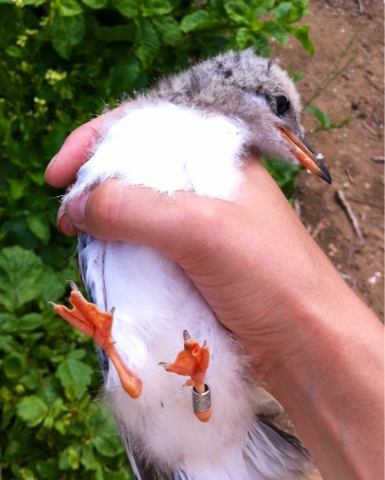
Every morning we do a "chick check". We comb the island for common tern chicks that haven't been banded already. They get a band if they haven't had one put on yet, and we record which nest or area they came from. I got to handle birds that ranged from being only a couple minutes old to what we call "elephants": the awkward teenagers that are actually bigger in size than their parents and are up to 45-48 days old. Here are just a couple I snapped pics of, showing the range of ages, from just out of the egg to almost fledging.
July 6, 2012
Great Gull Island - Day 1
I'm spending a week volunteering on a tiny island in Long Island Sound. Once a military fort, it is now an important breeding ground for thousands of terns; most are common terns, but there is also a decent population of the endangered roseate tern. The American Museum of Natural History has been running a project here to keep track of the terns for the past few decades. I will have the opportunity to take part in collecting and recording data for the project over the course of a week.
Here is the view from my room. Although there is very limited electricity (I'm currently running my iPhone on a solar charger) and the digs are quite rustic, the view and surroundings can't be beat! Stay tuned for more updates...

Here is the view from my room. Although there is very limited electricity (I'm currently running my iPhone on a solar charger) and the digs are quite rustic, the view and surroundings can't be beat! Stay tuned for more updates...
June 15, 2012
Adventures in Bird Banding

This morning I had the pleasure of joining Tait Johansson and the Bedford Audubon Society for bird banding at their study plot near Katonah, NY. The study is a part of the continent-wide MAPS (Monitoring Avian Productivity and Survivorship) program. This entails placing a small metal band around the leg of each bird that is caught, and recording its weight, sex, condition, age, and measurements. The information is used to find out how many birds return each year to breeding grounds, and will allow biologists to see if specific bird populations are declining and, if so, what the causes may be.
Since I was coming from Brooklyn, I had to be up at 3:15AM (ouch!), and by the time we reached the study plot, it was already light out.
We set about opening the ten mist nets (that look like huge, almost-invisible badminton nets), and then every hour we would check them for birds that would fly into them and harmlessly get caught in the netting. I had the opportunity to untangle some of the birds out of the nets, which was way more challenging than I thought it would be, but it was amazing to be able to handle them.

I got to help free this adorable juvenile Tufted Titmouse. Of all the bird species we dealt with, these were among the smallest, but by far the noisiest and feistiest. I now know what it feels like to be repeatedly pecked at and bit by a bird! Those tiny beaks have quite a grip.

Tait wrangles a Common Yellowthroat, a tiny warbler that breeds in the area.

Kristen bands an Ovenbird...

...and then shows off its pretty crown for the camera.

A Wood Thrush gets his wing measured.

I was taught how to properly handle and hold the birds.

My new Wood Thrush buddy sporting his new bracelet. Doesn't he look pleased?
Other birds species banded or recaptured: Veery, Downy Woodpecker, Hairy Woodpecker, Northern Cardinal, Gray Catbird.
Subscribe to:
Posts (Atom)